|
Critical Role of Vitamin D in Cancer
Treatment
Per Clinical Reports below,
Vitamin D deficiency has clearly been shown to be an
INCREASED risk factor
in multiple forms of cancer. This scientific research
indicates that maintaining high levels of
vitamin D can help offset negative side effects from Chemo
and Radiation
while also preventing
the progression of cancer & increase survival rates.
.
SCIENTIFIC RESEARCH ARTICLES
Each Cancer Patient needs to review
these published studies
and then, test
their 25-Hydroxy Vitamin D levels!
Circulating
Vitamin D levels in the Blood
Dramatically Reduces Death Rate
*
For
each 10ng/ml increase in the blood level of vitamin D,
the death rate from cancer would be reduced by 29%.
The relationship between vitamin D and colorectal cancer is
particularly strong. The
death rate for
colorectal cancer would
be reduced by 49%.
(30
-
Read Supporting Scientific Article)
| |
| ---------------------------- |
Vitamin D Levels
Highest during
Summer = Improves survival by 40%
* A
Norwegian study showed that cancer patients diagnosed
in the
summer
when
vitamin D levels are highest
had up to 40% better survival rates
than patients diagnosed in the winter when vitamin D levels
are at their lowest.
(56
-
Read Supporting Scientific Article
)
| |
| ---------------------------- |
Low
Vitamin D Levels
Greater chance
of Death & Metastasis
*
Breast cancer patients
with
low levels of
vitamin D followed over 11 years had a
70% greater
chance of dying and twice the rate of developing metastasis
than
patients with high levels of vitamin D.
(90
-
Read Supporting Scientific Article
)
| |
| ---------------------------- |
Lung Cancer Patients
Higher levels = Dramatic increase in
Survival
*
Early stage lung cancer patients who were diagnosed
in the
summer and had the highest levels of vitamin D had a
five-year survival of 73% compared to 30% for those
diagnosed in the
winter with low vitamin
D levels.
(60
-
Read Supporting Scientific Article)
| |
| ---------------------------- |
Lung - Colon - Prostate - Renal -
Endometrial Cancers
Higher Vit D
levels dramatically decreases Risk
*
High vitamin D levels
(based on latitude and UV exposure) also correlate with a
decreased risk of developing lung cancer, a 45% and
65% reduction in men and women respectively.
Similar effects have been demonstrated in colon, prostate,
renal and endometrial cancer.
(33
-
Read Supporting Scientific Article)
| |
| ---------------------------- |
Advanced Colorectal Patients
Risk of death
greatly Improved
*
The
risk of death for colorectal cancer patients
with advanced
disease but with high levels of vitamin D was
reduced by over 60%
compared to patients with low vitamin
D levels.
(64
-
Read Supporting Scientific Article)
| |
| ---------------------------- |
Prostate Cancer Patients
7 Fold reduced
risk of Death
* Prostate
Cancer Patients
with Vitamin D levels in the mid and high range had
a 60% and 85% respectively reduced risk of death
from the condition compared to patients with low levels of
Vitamin D. This is almost a
seven fold
increase in the risk of death in those with low vs high
vitamin D levels.
(152
-
Read
Supporting Scientific Article)
Ask your Doctor
for a
25-Hydroxy Vitamin D Blood Test

*Most Cancer Patients have Vitamin D blood levels
below <
40 ng/ml
Don't Be Fooled -- Order the Correct Test
There are two vitamin D tests --
1,25(OH)D and 25(OH)D.
The correct test is 25(OH)D, also
called
The
25-hydroxy vitamin D blood test
25(OH)D is the better marker of
overall D status. It is this marker that is most strongly
associated with overall health.
Please note the difference between normal and optimal. You
don't want to be average here; you want to be optimally
healthy. Primitive man likely developed in tropical and
sub-tropical conditions with large exposure to UV-B and its
secondary consequence to skin exposure, vitamin D.
Primitive environmental availability of a nutrient does not
necessarily establish the higher requirements, but these
exposures would have influenced the evolution of the
relevant physiology, and such concentrations should at least
be considered presumptively acceptable.
Some experts may disagree with the following healthy ranges,
but they are taken from healthy people in tropical or
subtropical parts of the world, where they are receiving
healthy sun exposures. It seems more than reasonable to
assume that these values are in fact reflective of an
optimal human requirement.
| |
| |
| |
 |
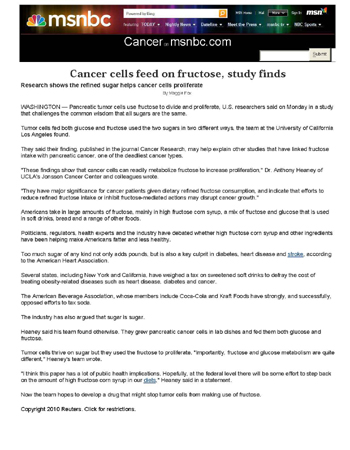
Cancer's Favorite Food -
Found in Everything You Eat?
Posted By Dr. Mercola |
August 27 2010
Check the ingredients of
everything you eat or drink!

Beware of High Fructose Corn Syrup
Click below to read both articles from
MSNBC and Reuters
|